
It won’t come as a surprise that life cycles for every species can differ. Each one has its own timeline and evolutionary process from courtship to pregnancy, through to adulthood.
But if you’ve ever assumed that it’s always the female’s job to carry and birth the offspring, we’re here to prove you wrong. Seahorses are the exception to the rule, so allow us to explain why this sea creature is so exceptional in this guide to their life cycles.
Do male seahorses give birth?
Yes! Male seahorses are always the ones to carry and nurture embryos, then give birth to the babies.
In fact, seahorses are the only known male species to give birth instead of females.
Why do male seahorses give birth?
This responsibility falls on the males as an evolutionary strategy that allows for much faster reproduction. While the males are carrying and nurturing embryos in a specialised pouch, the females are immediately free to produce the next batch of eggs.
This means they can continuously produce and nurture eggs throughout the entirety of the breeding season.
Seahorse offspring are in danger from predators for the first few weeks of their lives, so this strategy maximises the number of offspring that can survive.
Interestingly, though, female seahorses carry the eggs initially, and these are fertilised during courtship. It’s only after fertilisation that the eggs are transferred to the male seahorses.
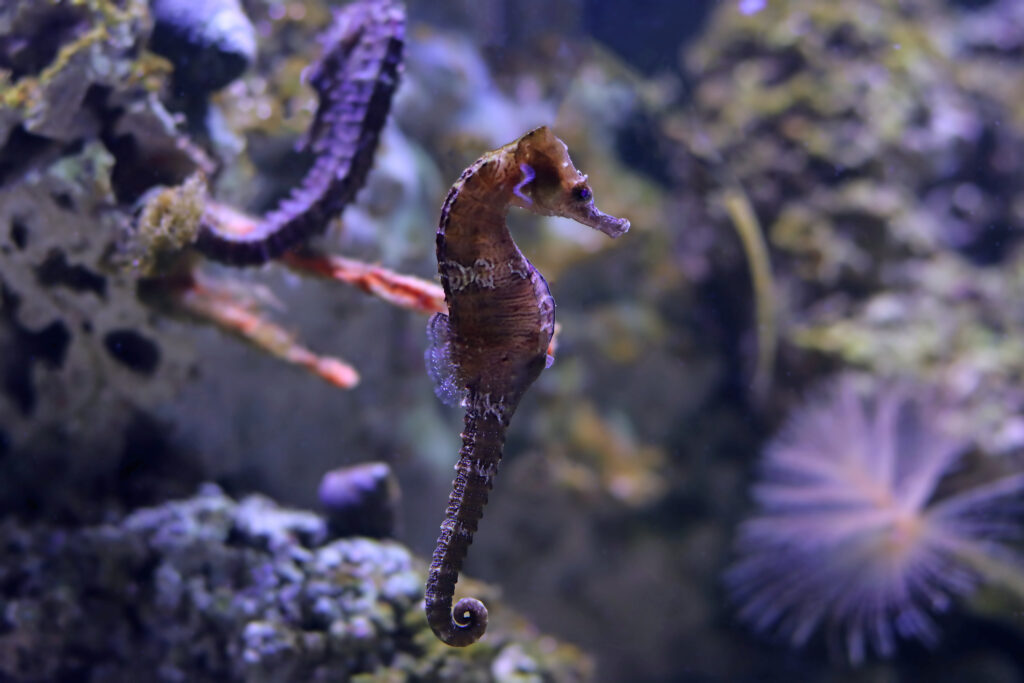
Life cycle of a seahorse
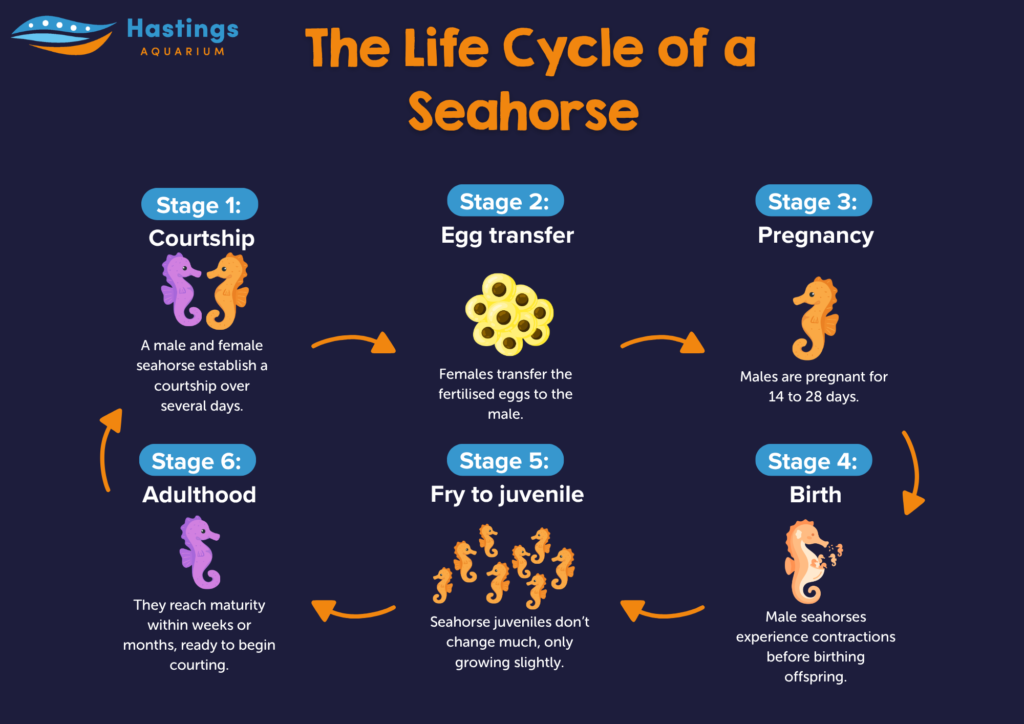
Let’s look at each stage of a seahorse’s life cycle, from start to finish.
Courtship
Most seahorse species will mate for life, or at least stay together for several brooding seasons. Many will even anchor their tails together so they aren’t separated – even in rough waters or when they’re threatened by predators.
Courtship can last several days and can involve a dance and colour changes, alongside intertwining the tails. Males can even expand their brooding pouch to show off its emptiness.
Female transfers eggs to male
Here’s where the parenting roles become unconventional. Once the eggs are fertilised from the mating, the female uses a special organ called the ovipositor to transfer them to the male.
Male seahorses have a specialised brooding pouch designed to provide oxygen and nutrients to the eggs, which is where they remain for the duration of the pregnancy until birth.
Pregnancy
Also known as gestation, male seahorses normally experience pregnancy for 14 to 28 days. During this time, the males protect the eggs and supply oxygen to help them develop.
Birth
When a male seahorse is ready to give birth, it will have muscular contractions similar to the human birth experience. The contractions eventually expel their offspring, which are known as fry.
Seahorses can give birth to thousands of offspring in just one litter, depending on the species.
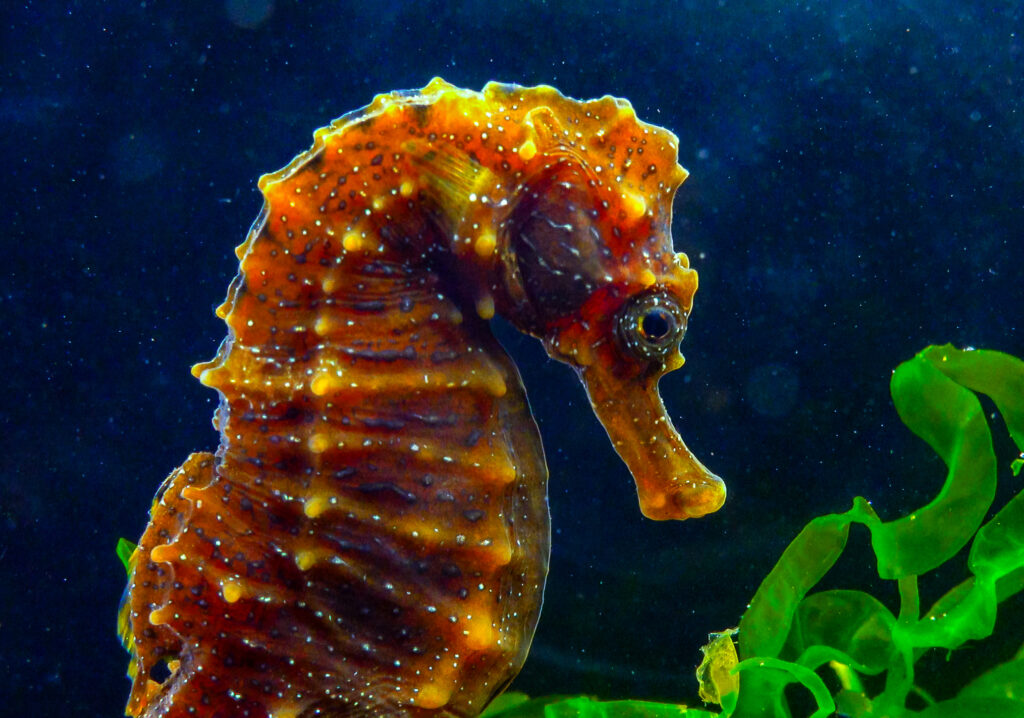
Fry to juvenile
Newborn seahorses are incredibly small – measuring just 2 to 12 millimetres. Their anatomy stays mostly the same from birth as they grow into juveniles, although some species will lose a small fin they were born with.
Adult
Seahorses can reach maturity within a matter of weeks or months, depending on the species and water conditions. Once they reach adulthood, they can begin the life cycle process again.
Life cycle of a seahorse poster
Learn more about seahorses at Hastings Aquarium
Still want to learn more about these saltwater sea creatures? You’re in luck – we could never get tired of sharing our favourite seahorse facts.
Hastings Aquarium is also home to the lined seahorse (Hippocampus erectus), which you would normally only catch a glimpse of in the warm waters of the western Atlantic Ocean stretching down to the Gulf of Mexico.
So why not book your tickets for your next visit to Hastings Aquarium, where you can get up close to our very own seahorses!