
Scorpions are exciting creatures that can thrive all over the world thanks to their unique features. So, let’s get to know them a little better with a quick guide to their anatomy, from their pincers to their stingers.
What is a scorpion?
Scorpions (Scorpiones) have been on Earth for millions of years, even since the dinosaurs were around! It’s thought that they might’ve been one of the first animals to move from water to land hundreds of millions of years ago, based on scientific evidence.
They’re predatory arachnids, feeding mostly on small insects like crickets, ants and spiders. Scorpions are also classified as invertebrates and belong to the same family as spiders and ticks.
What does a scorpion look like? Anatomy explained
Scorpions are well-known for having a unique appearance. Their body colour can vary between species, with some displaying green-grey hues and others being red and black. Their exoskeletons are also UV fluorescent, although the reason for this remains a mystery to scientists.
Scorpions can vary in size depending on their species, with the smallest species being the Microtityus fundorai from the Caribbean. This tiny scorpion measures just half an inch on average! In comparison, the largest is the giant forest scorpion, which can grow up to 9 inches in length.
Ready to find out more about their key anatomy features? We’ve broken it down for you below.
Pincers
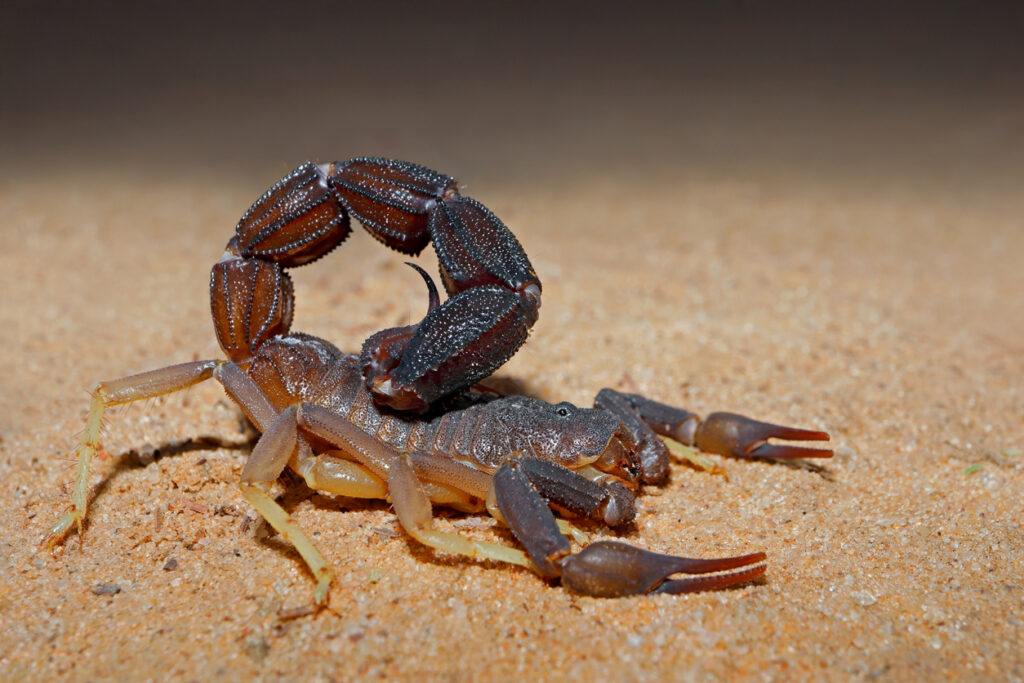
When you think of a scorpion, one of the first things you might picture is their pincers. Large and claw-like, these are located at the front of the body and help a scorpion grab food, defend against predators, and warn off potential threats.
Stinger
The stinger is found at the end of the tail and has a curved, needle-like appearance. When a scorpion feels threatened, the stinger expands to inject venom into its victims. The venom is stored in the abdomen, ready to be released whenever necessary.
Legs
Scorpions have four pairs of legs, with four on each side of their bodies behind each of the pincers. These are primarily used for walking, although they also help scorpions with stability.
Eyes
With scorpions being nocturnal, their eyes have adapted for optimal vision at night. They have two sets of eyes: lateral and median.
Their lateral eyes are found at the front of their head, and depending on the species, they might have between 2-5 eyes here. These eyes are typically used for detecting motion and navigating surroundings.
Meanwhile, the median eyes are found further back on the head. Most scorpions will only have one set of median eyes, and these are more sensitive to light than the lateral eyes. These eyes are larger, giving them a broader field of vision in lower light conditions.
Abdomen
The abdomen is a vital part of a scorpion’s anatomy and survival. It houses vital internal organs, such as the digestive system, reproductive organs and respiratory structures. Within this elongated part of the scorpion’s body, the organs are kept safe and showcase this creature’s ability to adapt for survival over millions of years.
Tail
Also known as the metasoma, the tail is used for multiple purposes, including hunting, digging and defence since the stinger is located at the end of the tail. Many scorpions will burrow underground, and their tails have adapted to help them do this effectively.
Labelled scorpion anatomy poster
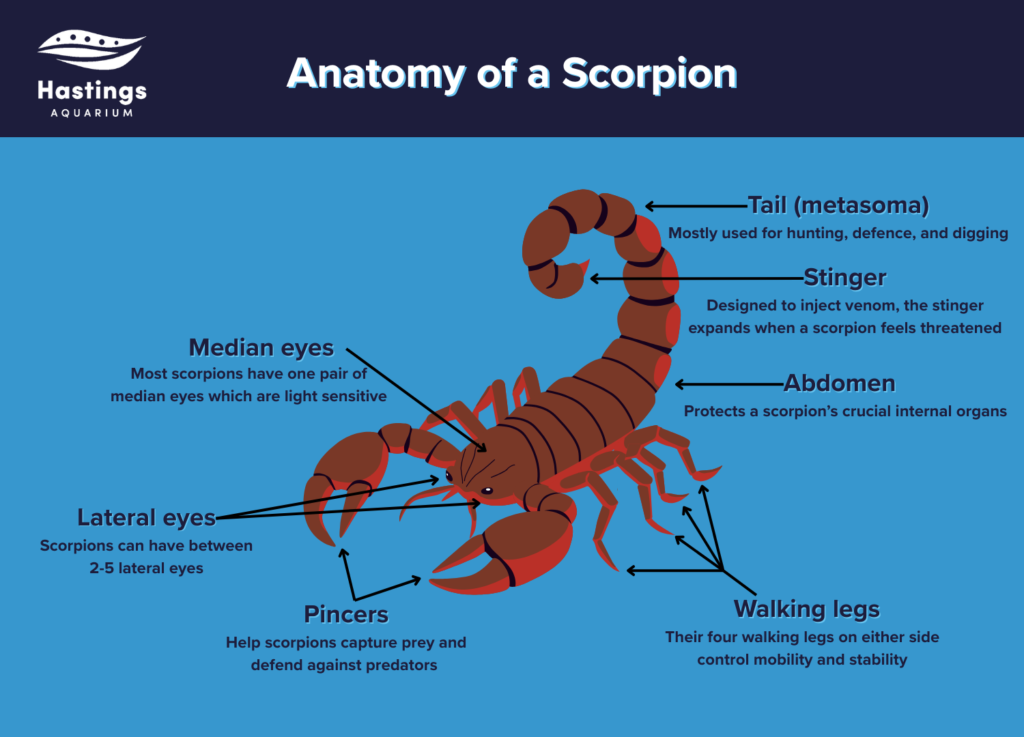
So, what does all this look like? Check out our poster to see where all the key anatomy features of a scorpion can be found.
Spot scorpions at Hastings Aquarium
Here at Hastings Aquarium, we have our own resident scorpion species, which you might spot in our Jungle Room exhibit. Our Asian forest scorpion (Heterometrus spinifer) has a grey-green appearance and packs a venomous punch in its stinger, although this isn’t lethal to humans. This species prefers moist forest habitats and spends most of its time hiding under logs or debris. It even burrows underground sometimes, so you might need to wait a while to spot it!Come along to Hastings Aquarium to see our Asian forest scorpion, alongside plenty of other marine creatures, up close and personal. Book your tickets in advance to secure your spot!