
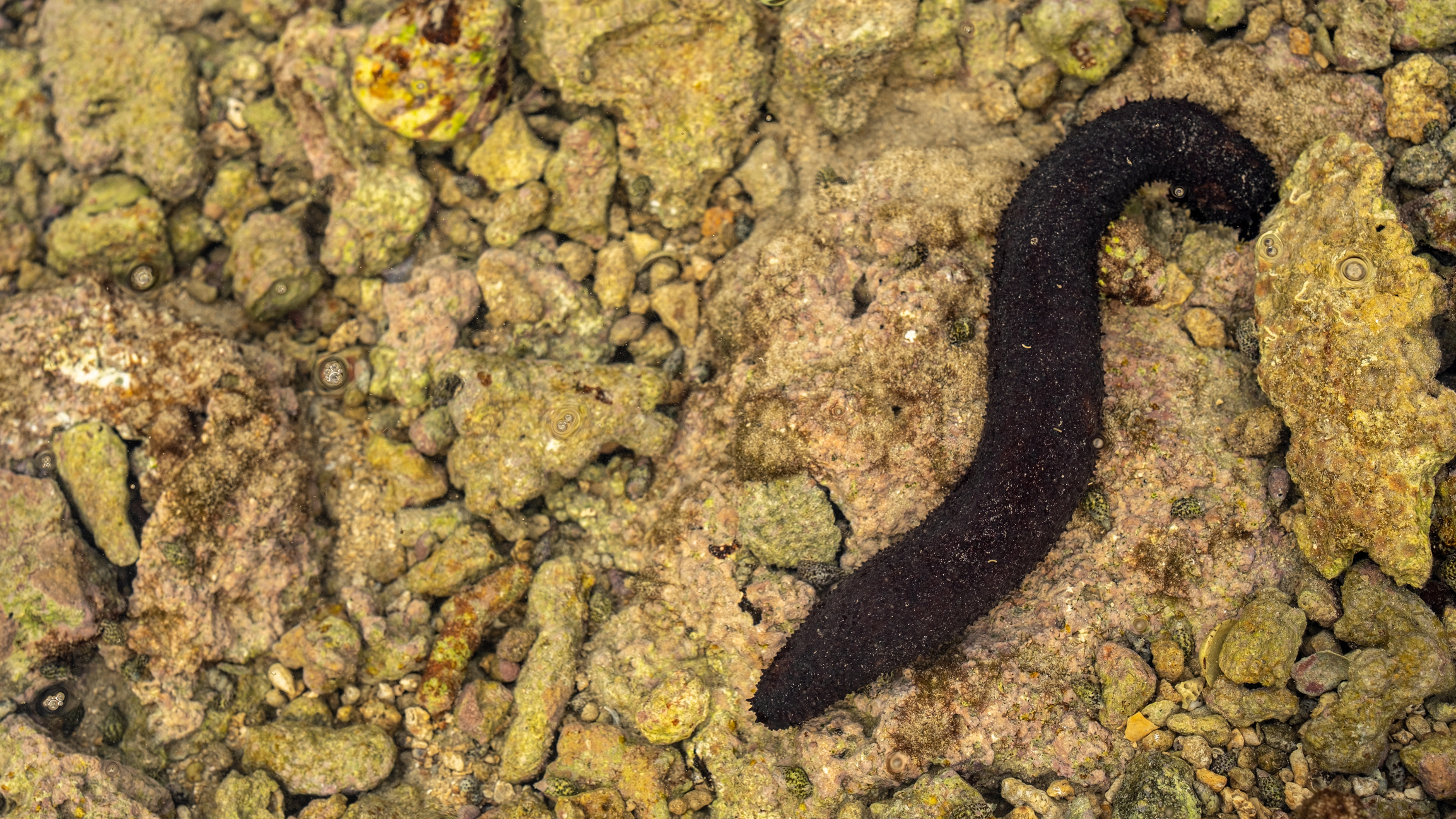
The black sea cucumber (Holothuria forskaliis) is a fascinating marine invertebrate. It belongs to a group of animals called echinoderms, which are loosely related to starfish and sea urchins.
What is a Black Sea Cucumber?
With its soft body and slow movements, this unusual ocean creature might not seem very exciting at first, but it plays an important role in keeping the seafloor clean and healthy. There is much more to this humble animal than meets the eye…
Role of Black Sea Cucumbers in the Ocean
Did you know that black sea cucumbers play an important role in ocean ecosystems? As they feed, they swallow large amounts of sand, consuming waste, bacteria, and algae that could otherwise damage the coral reefs. Inside their bodies, the organic matter and harmful bacteria are broken down, and clean sand is released back into the ocean. In this way, sea cucumbers act as natural cleaners, helping to maintain healthy and balanced underwater environments
What do Black Sea Cucumbers Look Like?
The black sea cucumber typically has a deep black or brown cylindrical body, giving it a soft, cucumber-like appearance. Its body is divided lengthways into five bands, lined with thousands of tiny hydraulic tube feet (called podia) that help it move and cling to rocks. Around its mouth are 20 black tentacles, which it uses to scoop up sand and organic matter. Surprisingly, this simple creature has no eyes or brain, yet it is perfectly adapted to life on the ocean floor.
Native Habitat
Black sea cucumbers are found all over the world (even here in the UK!) but are most common along the shallow reefs of southern shorelines. Here, they depend on rocky terrain for shelter. They often hide by wedging themselves under boulders or within rock crevices for protection against predators and strong currents. If you look carefully, you may see them covering themselves in a layer of sand. This behaviour is thought to help protect them from strong UV rays in these shallow, sunlit waters.
Interesting Behaviours
Sea cucumbers have a strange but remarkable defence mechanism known as evisceration. This is when they expel a white, sticky, string-like substance from their bodies. Although it looks strange, this material is actually made up of their internal organs, released when they feel threatened. The tangled mass can distract predators and may even be toxic if eaten, giving the sea cucumber a chance to escape. Even more surprisingly, they are able to regenerate these lost organs within a few weeks, while relying on stored energy reserves in the meantime. This unusual adaptation is their main form of defence, making it an important survival strategy.
Conservation Status
Fortunately, this species is not currently considered endangered, as it is widely distributed and its populations are not under significant threat. However, many other species of sea cucumber face severe pressure from overfishing to supply luxury seafood markets in Asia. This makes it especially important to raise awareness of the vital role sea cucumbers play in marine ecosystems.
Learn More about Sea Cucumbers in our Native Zone
Come and discover the black sea cucumber for yourself in our Native Zone! This exhibition showcases a number of species you may have heard of but never seen in real life. It’s the perfect opportunity to get up close and learn more about the animals that call the UK home. If you’re lucky, you might even spot the sea cucumbers!
Type
Echinoderm
What do they eat?
Sand, sediment and organic debris
Size
Up to 30cm in length
Water Type
Saltwater
Where are we?
All over the world