
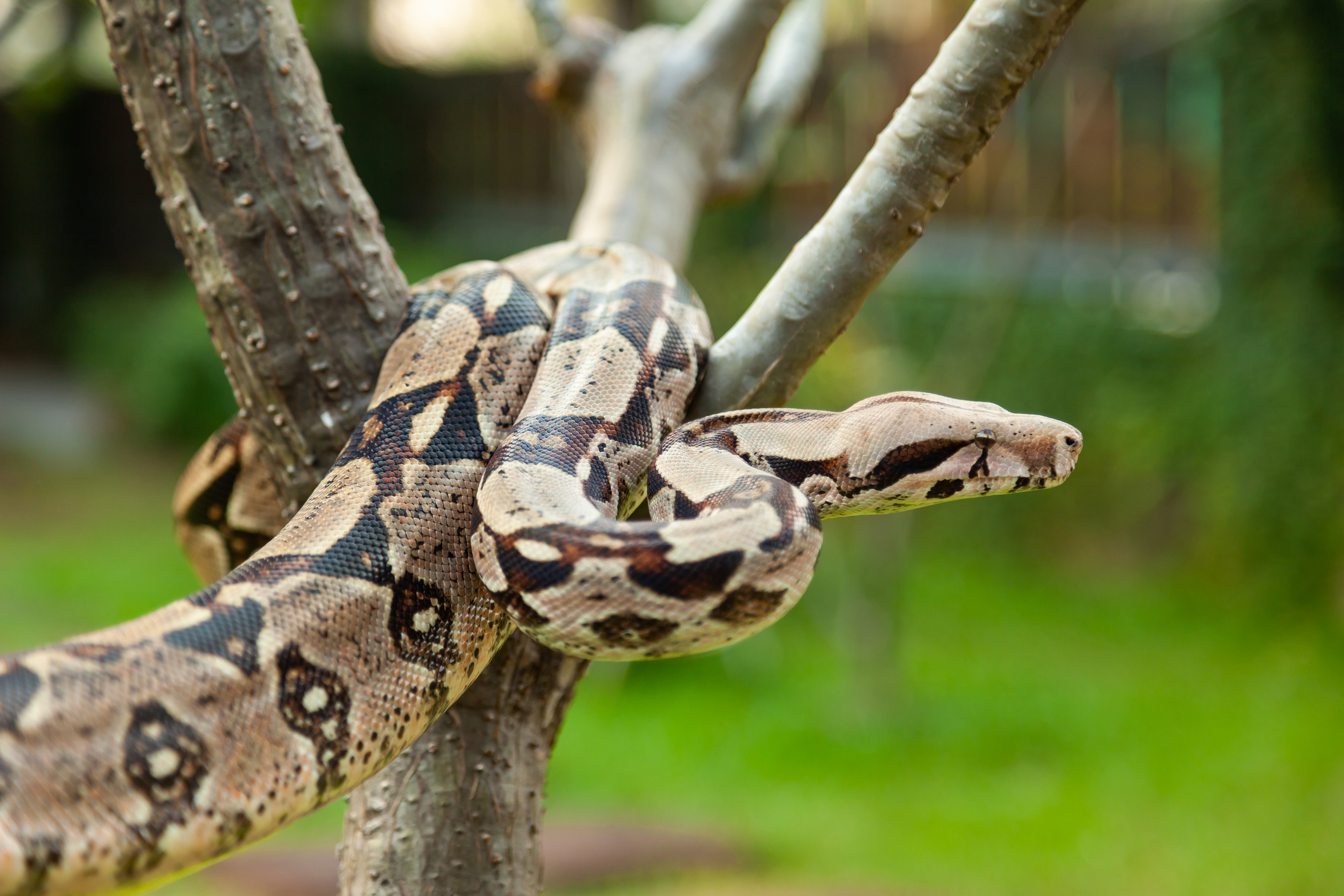
With beautiful, bold colouring and mind-blowing strength, the boa constrictor (Boa constrictor) is one of the jungle’s most famous residents.
Boa Constrictor Overview
The boa constrictor is a large species of non-venomous snake. Found all across Central and South America, the boa is adapted to live in environments ranging from rainforests to savannahs, woodlands to mountains.
They get their name from their incredible strength throughout their bodies that they use to wrap around prey and squeeze very, very tightly.
What does a Boa Constrictor Look Like?
A boa constrictor is a large snake reaching up to 10 feet in length and weighing up to 15 kilos. Their thick bodies are usually brown, grey or cream, with patterns of circles and bands to camouflage them in their natural habitat. For this reason, the pattern you’ll see on a boa constrictor is dependent on where it originates.
At the top of their muscular bodies, you’ll find an arrow-shaped head that is filled with four rows of razor-sharp teeth. They use these teeth to anchor themselves to their prey while they wrap around and constrict. Crucially, boa constrictors are not venomous, so they rely on over 100 needle-like teeth to secure their prey, not to inject venom.
Native Habitat
A boa constrictor’s native habitat can be varied, including tropical rainforests, woodlands, savannahs, and semi-deserts, usually with water sources nearby. As juveniles, they prefer the safety of trees and abandoned burrows. Not only does this allow them to hide from some predators, but it also allows boas to hunt prey more effectively.
As they grow larger, and they become too heavy to climb efficiently, they are most commonly found on the forest floor, slithering through leaf litter almost unseen and unheard. Their enormous size means that they only travel at about 1 mile per hour and strike at approximately 2.7 metres per second.
Diet and Hunting Techniques
The boa constrictor’s diet consists of a variety of small animals, including rodents (rats, mice), birds (chicks, quail), rabbits, lizards, and bats. As we mentioned, boa constrictors are non-venomous, so they must rely on striking quickly, latching onto their prey and slowly wrapping themselves around the animal.
Boas swallow their prey whole, and after a large meal they won’t need to eat again for a few weeks! On the other hand, juvenile boas need to eat every 7-14 days to help their rapid growth into adulthood.
Boa Constrictor Conservation Status
The boa constrictor is listed as Least Concern because of their high adaptability across a range of habitats. However, they still face significant threats of habitat loss as human activity continues to impact the natural world.
For example, large areas of South American rainforests are being deforested to make way for large-scale agriculture projects, displacing millions of animals in the process.
5 Must-Know Boa Constrictor Facts
- Boa constrictors are good swimmers and can swim with their heads above water, but they do prefer to live on land.
- The name for a group of boas is a bed or knot, although they are mostly solitary animals.
- Boa constrictors give birth to live young, known as ovoviviparity. They can give birth to around 60 babies at once!
- Boa constrictors are nocturnal animals, so they are most active at night.
- The boa constrictor will flick its tongue from side to side, helping it to detect odours.
Find Us in the Jungle Room!
If you’d like to see boa constrictors in an environment that expertly mimics their natural habitat, come on down to the Jungle Room at Hastings Aquarium. The Jungle Room is filled with incredible flora and fauna that you’d find in the jungles of South America.
At Hastings Aquarium, we also have plenty of friendly staff on hand to answer any questions you might have, so don’t hesitate to ask. You can even learn during one of our talks or feeds.
If that sounds like your idea of a great day out, book your tickets now!
Type
Reptile
What do they eat?
Small animals, including rodents (rats, mice), birds (chicks, quail), rabbits, lizards and bats
Size
Up to 10ft in length
Water Type
Land species
Where are we?
Central and South America