
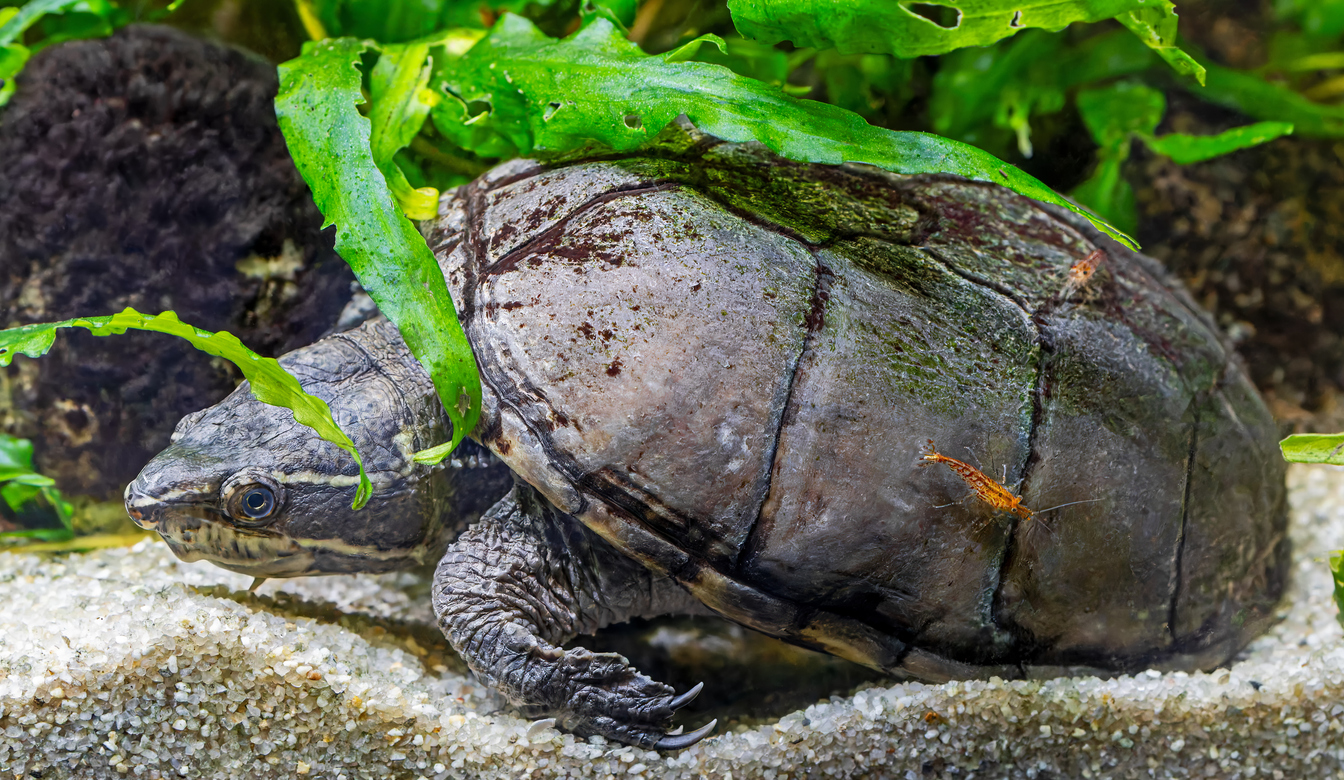
Here we’ll learn all about the common musk turtle, including some interesting facts about its appearance, behaviour and where they live!
Introducing the common musk turtle
You need only look to the common musk turtle’s scientific name, Sternotherus odoratus, for a clue as to this critter’s secret weapon – it’s capable of quite the odour!
While the common musk turtle may be small, it sure knows how to leave a lasting impression. That’s thanks to special glands near its shell that produce quite the stench when it feels threatened – an ability that’s led the musk turtle to develop the not-so-flattering nickname, “stinkpot”.
Part of the Kinosternidae family, the common musk turtle is also known as the Eastern musk turtle too.
Appearance and features
The common musk turtle is a small freshwater turtle, with adults reaching a shell length between 8-15cm. Their upper shell, known as the carapace, is a high domed structure and typically coloured olive-brown, grey or black. Their distinctive feature is two bright yellow stripes that run horizontally on each side of its head. They also have a sharp snout and beak.
Common musk turtles also have small barbels on their chin and throat, which act as sensory feelers to help them find food along the dark riverbeds. They have strong jaws and are able to reach backwards with their long, flexible necks.
Native habitat and range
The common musk turtle is native to North America. It ranges from southeastern Canada down through the eastern and central United States, reaching south to Florida, the Gulf Coast, east to Texas, and west to Wisconsin and Nebraska. Here, it spends its days in shallow, slow-moving freshwater, often in wetland areas.
Despite being a natural water-dweller, the common musk turtle isn’t the strongest swimmer. Instead, it essentially walks on the riverbed, foraging in the shallows. Common musk turtles are adept at climbing, often using fallen logs and trees as shelter. Like other turtles, the stinkpot lays its eggs on dry land, nesting among leaf litter within a few metres of the water’s edge.
Interesting behaviours
Common musk turtles are able to tolerate low-oxygenated and muddy environments, using their barbels to extract small amounts of oxygen from the water. They are known to be crepuscular and nocturnal, being most active during the night, early morning and late evening hours. They will undergo a process known as brumation in colder weather, which is a type of hibernation where the common musk turtle will slow down its metabolism and burrow into the muddy bottoms of the water.
Common musk turtles are opportunistic and are omnivores, eating whatever they can find including aquatic insects, snails, small fish, worms and plant matter.
Find Us In the Jungle Room!
Here at Hastings Aquarium, we play host to a clutch of common musk turtles over in our Jungle Room Exhibit. Can you spot these palm-sized critters amongst the colourful flora of their tropical home?
Type
Reptile
What do they eat?
Crayfish, clams, shells, and insects
Size
5-15 cm
Water Type
Freshwater wetlands
Where are we?
Canada and the Eastern US