
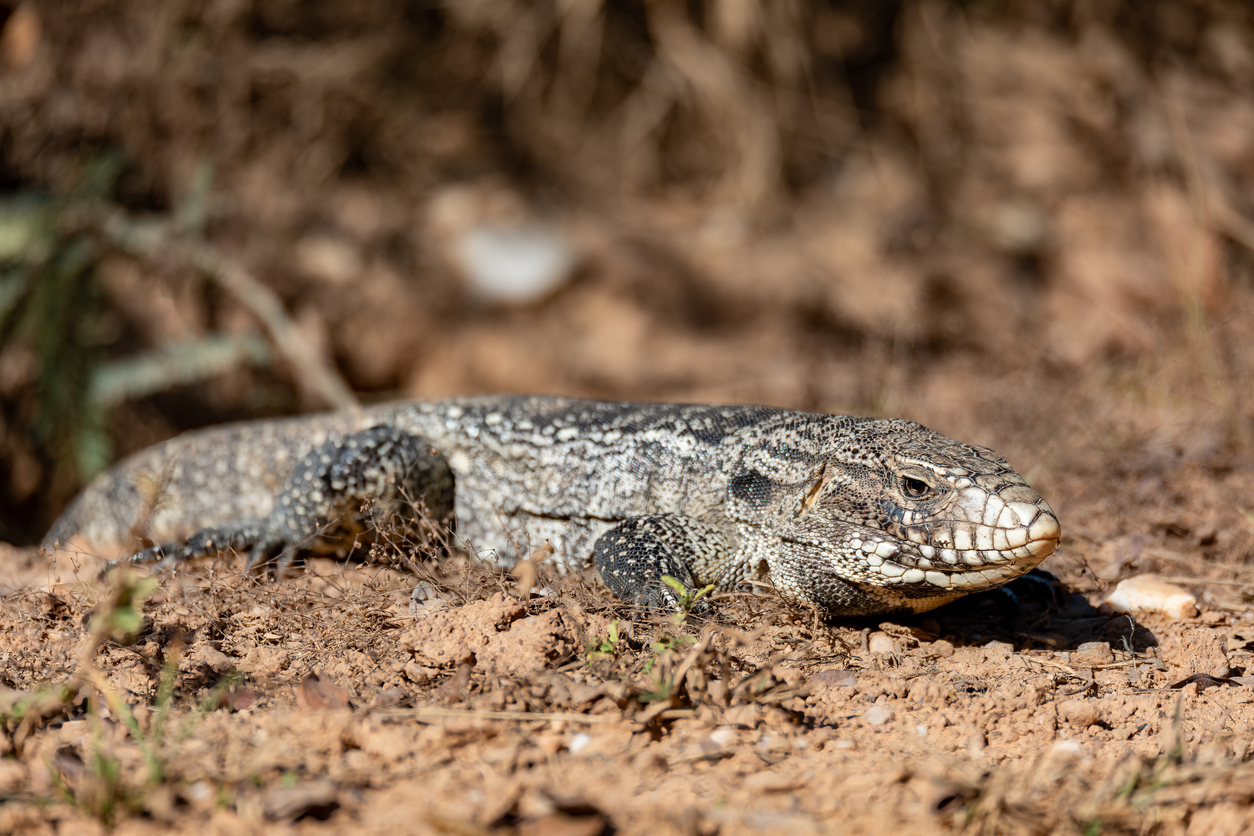
Across South America, there is an animal found in environments from tropical rainforests to savannas that is the stuff of nightmares for rodents and small birds. Thankfully, for us humans, it’s just a beautiful lizard that commands great respect.
With black and white markings and a long, forked tongue, the Argentine black and white tegu (Salvator merianae) is a large, agile lizard that can reach speeds of up to 20mph.
It’s South America’s largest lizard, and it’s also Hastings Aquarium’s largest lizard.
Let’s take a look at what makes the Argentine tegu such an incredible animal.
Key Appearance Features
The Argentine black and white tegu is instantly recognisable for its striking black-and-white beaded skin that mottles its body. When they’re born, they have green heads, but after 1-3 months, their skin sheds to reveal the deep black that we know them for.
As we mentioned, they’re large lizards, with males reaching up to 5ft (1.5 metres) in length, and females growing to about 3.5 feet (1 metre) in length.
A lot of their length is in their powerful tails, which are used as whip-like weapons against predators. And, although it’s rare, tegus can drop their tails and leave it behind when they feel severely threatened to distract a potential predator.
You might also notice its forked tongue that it uses to “smell” prey, much like a snake.
Native Habitat and Range
As we mentioned, the Argentine tegu can be found across Eastern and Northern South America in Argentina, Brazil, Paraguay and Uruguay. They typically live near water because they are semi-aquatic lizards, typically found in tropical dry forests, rainforests and shrubland. They can hold their breath for up to 20 minutes and use this time to catch prey or avoid predators.
Diet and Hunting
Tegus have quite a varied diet. They eat insects, small vertebrates like rodents and birds, eggs, and even fruit and vegetables. The young tegus typically eat a higher percentage of insects compared to adult tegus. This is because of the abundance of insects and their high protein content, which helps juveniles to grow quickly. As tegus grow into adulthood, they tend to feed more on vegetation.
Behaviour
Despite being quite a prolific predator, larger animals do prey on the Argentine tegu. When threatened by animals like jaguars or even snakes, the tegu will hiss loudly to warn off the predator and then inflate its body by opening its mouth wide and swallowing air to inflate its lungs and surrounding area to stretch its skin.
If that fails, it’ll use its agile body to run away as quickly as it can, potentially leaving its tail behind to distract the predator.
In general, tegus are solitary animals, only gathering for breeding or, occasionally, shared brumation (hibernation). They are incredibly territorial animals and will protect their territory fiercely.
Argentine Tegu Conservation Status
Argentine black and white tegus are currently listed as Least Concern because of their strong distribution across South America. They’re so adaptable that they’re even considered an invasive species in the southern United States, particularly in Florida.
Find Us in the Jungle Room
If you’re keen to see an Argentine black and white tegu in the flesh, you can see them at the Jungle Room Exhibit at Hastings Aquarium, alongside other animals that would be in similar natural habitats, like the tree python or the African bull frog.
During your visit to Hastings Aquarium, you’ll have plenty of time to listen to our team of experts tell you about the Argentine tegu during one of our talks. You’ll even be able to ask our team any questions so that you can learn even more about these amazing animals. Don’t forget to book your tickets online today!
Type
Reptile
What do they eat?
Insects, small vertebrates like rodents and birds, eggs, and fruit and vegetables
Size
Up 1.5m
Water Type
Tropical rainforest and shrubland
Where are we?
Eastern and Northern South America