
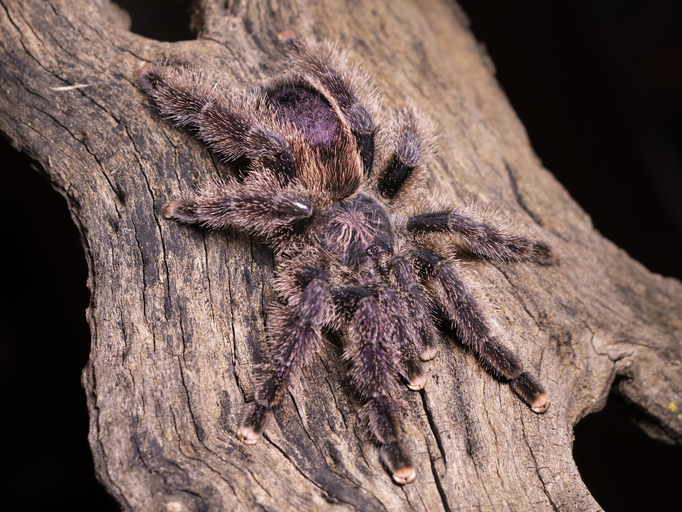
Belonging to the Avicularia genus, commonly known as pinktoe tarantulas, is a striking species native to the tropics. Find out all about this creature and see it for yourself at Hastings Aquarium.
Introducing the pinktoe tarantula
The pinktoe tarantula (Avicularia avicularia) is from the family Theraphosidae, containing over 1,000 different species. As with most other spiders in this family, the pinktoe tarantula is a large, hairy creature and is a New World tarantula. You might also see it named the Guyana pinktoe or South American pinktoe.
Physical characteristics and appearance
As with many creatures in the animal kingdom, the pinktoe tarantula gets its name from its appearance. Adults typically have a darker body with contrasting pink colouration at the ends of their legs. You might notice a faint metallic sheen to the body, in a green, teal or blue hue. However, juveniles are the opposite colouring, usually starting with a pinkish body and dark feet before reversing their colours as they mature.
Its body is covered in fine setae, a type of bristle or hair-like structures. As the pinktoe tarantula is a New World species, they have urticating setae, which means they can flick these hairs off towards threats, causing stinging and irritation.
Pinktoe tarantulas are known to have a body of around 5-6cm in length and 10-13cm leg span. Females are usually larger, known as a type of sexual dimorphism. This species, like other tarantulas, have venomous fangs that fold downward under their body.
Native habitat and range
Pinktoe tarantulas are found across northern South America, including Venezuela, Brazil and Guyana. They are also sometimes found across the Caribbean islands. Pinktoe tarantulas are an arboreal species, meaning they live amongst the trees, which is why they thrive throughout the rainforests of South America.
The pinktoe tarantula will build silk retreats up in the trees, resembling silk web-tubes. They wait and hide for prey to pass by, which typically consists of insects.
Quick fire facts about the pinktoe tarantula
There’s still so much more to learn about this fascinating species. Here are some extra facts!
- The female must have recently molted in order to reproduce. They can lay from 50 to 200 eggs, that they wrap into a ball and guard until they hatch.
- Pinktoe tarantulas will typically hunt at night, sitting at their retreat entrance and relying on rapid pounces on their prey.
- They prefer retreating when under threat, and may flick their hairs or faeces instead of choosing to bite.
- During the first year, young offspring can molt up to 6 times to help them grow.
- Their most common predator is the spider wasp, as well as hawks, weasels and snakes.
Pinktoe tarantula conservation status
The pinktoe tarantula hasn’t been assessed by the IUCN Red List, but we do know that they can face some conservation challenges due to habitat loss and illegal pet trade. They have a widespread distribution but they could be at risk in the future due to deforestation or destruction of their native rainforest habitat.
There are some more localised populations of pinktoe species that may face more pressure, like the Antilles pinktoe tarantula (Caribena versicolor).
Find us in the Jungle exhibit
You’ll find the pinktoe tarantula in our Jungle exhibit, the perfect home for species that live in more tropical environments. You’ll also find species like the boa constrictor, panther chameleon and Madagascan day gecko!
Type
Arachnid
What do they eat?
Insects
Size
10-13cm leg span
Water Type
Tree-dwelling
Where are we?
South America