
There are around 4,000 snake species on Earth, all of which are unique to their environments and survival needs. But these curious creatures all share very similar anatomy across the different species, which is rarely talked about beyond the fact that they have no limbs.
Let’s take a look at the major body parts of a snake, from their clever adaptations to the lesser-known facts about these slithering serpents.
Snake anatomy explored
Snake anatomy is truly a fascinating subject. From their fangs and forked tongues to their scales and tails, the poster below shows off the main anatomical aspects most snake species share and where these can be found.
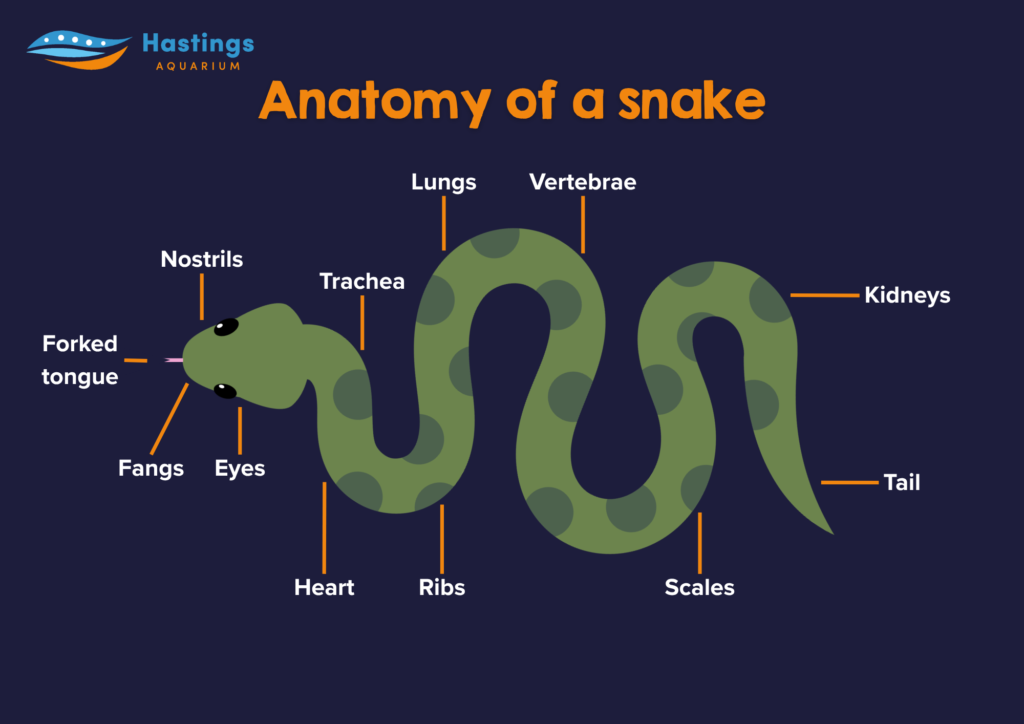
Do snakes have bones?
It’s the question on everyone’s fork-shaped tongue, and the answer is yes – snakes do have bones. Snakes are classified as vertebrates, which literally means they have a backbone. Their slender bodies house an entire skeletal system, including a skull, spine, ribs and tail bones. Some larger snakes have up to 1,000 bones in total, with up to 400 vertebrae in their spines.
Thanks to their extensive bone structure, snakes have a lot of flexibility, which is key for their unique movements. This is mostly down to their two sets of ribs, which can move independently of one another.
Their ribs also play a crucial role in their survival since they’re used to create the changes in pressure necessary for snakes to breathe and make room for large food items.
Do snakes have tails?
Yes, snakes have tails. But the tail takes up a much smaller portion of a snake’s body than you might originally think, starting after the ribcage ends.
Most male snakes have longer tails than females, which scientists believe is an adaptation that makes them more successful during mating.

Do snakes have legs?
Snake ancestors more closely resembled lizards, which means they had 4 legs to help them move around. Over time, though, the modern-day species lost its legs as it evolved and adapted to survive. Today, there are no known snake species with any limbs.
Do snakes have ears, and can they hear?
Snakes do not have external ear flaps, ear canals or eardrums. But they do have functional inner ear bones, giving them a sense of hearing.
This hearing is mostly reliant on vibrations, which they feel by resting their lower jaws on the ground where they can easily detect sound frequency. Snakes use these vibrations to locate prey and predators, giving them a clever advantage over even the quietest of creatures.
Do snakes have eyelids?
Snakes don’t have movable eyelids, nor can they blink or close their eyes. Instead, they have a small scale covering each eye, called a brille. The brille offers protection for their eyes, and because this is always covering the eyes, snakes technically always have their eyes closed.
If the brille becomes damaged, it will shed alongside the rest of the skin and regenerate.
Do snakes have teeth?
All snake species have teeth, including fangs and smaller functional non-fang teeth. The non-fang teeth often point backwards, hidden in the gums.
The number of teeth a snake has will usually depend on the species. For example, the mountain many-tooth snake(Sibynophis collaris), native to South East Asia, really lives up to its name with 35 to 50 teeth across several separately moving jaw sections.
One species that has no fangs and only very small teeth is the brahminy blind snake (Indotyphlops braminus). It primarily eats larvae, ants and termites and lives underground, so it has no use for big, powerful teeth.
Most species have two fangs and 100 to 200 other teeth.

How do snakes use their tongues?
Snakes are well-known for their forked tongues, but what are they used for?
The main purpose of a snake’s tongue is for smelling. The tip of the fork can sense chemical molecules from the air, water and ground. Snakes also use their tongues to seek food, protection and mates, all without even having to open their mouths or use their noses.
Because of this adaptation, their nostrils only focus on breathing and aren’t used for smelling like us humans.
Why do snakes have scales?
Snake scales aren’t just for decoration – they provide protection, hydration and can even help snakes move around. Specifically, the scales on a snake’s underside are used to grip the terrain as it slithers around on land, in water and even climbs trees in some cases.
They’re dry rather than slimy, and snakes can shed their skin to accommodate growth and keep their health in tip-top shape.
Learn more about snakes at Hastings Aquarium
Slither over to our Jungle Room exhibit to see our snakes in action and learn more about their anatomy, behaviours, habitats and more.
This exhibit is home to the tree python (Morelia viridis), growing up to 2 metres in length and with a slender, laterally compressed body which helps it coil around thin tree branches. This snake species can wiggle its tail to attract prey and strike at the exact right time. You can also say hello to the boa constrictor, famous for the way it can wrap its body in a tight coil around prey and squeeze.
Book your tickets to Hastings Aquarium today, where you can see snakes and other exciting marine creatures up close!